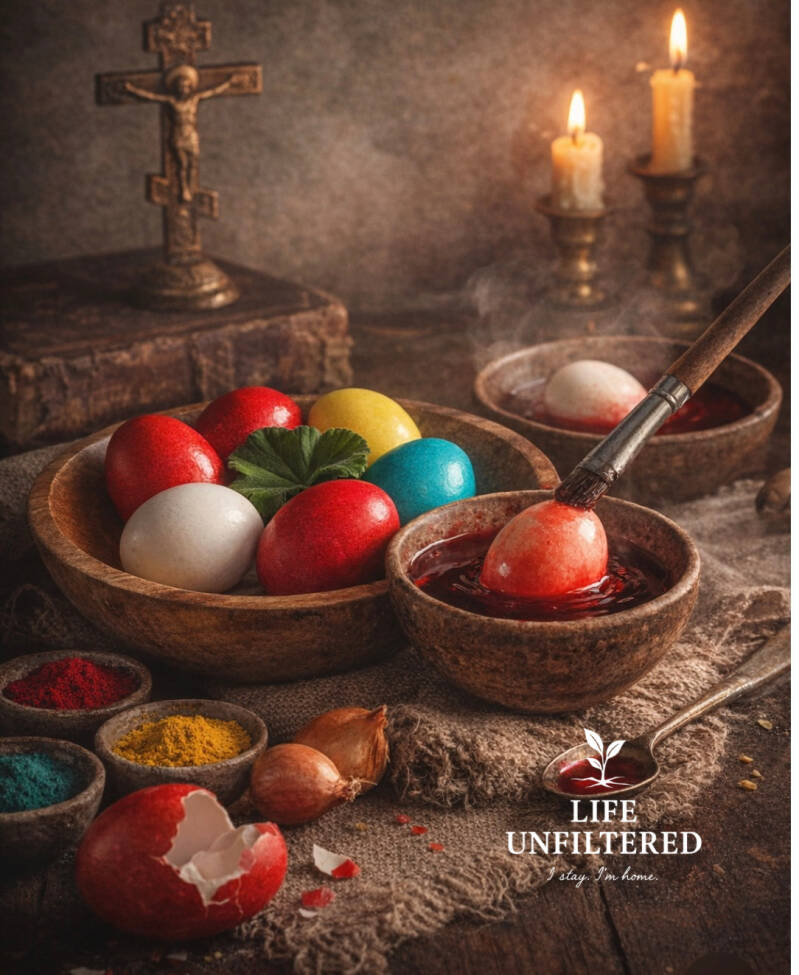
Today, we dye eggs, not because we question it, but because tradition calls for it, because the canon has preserved this gesture through centuries as a sign of something greater than ourselves, a quiet reminder that there is an order that does not depend on our moods, and a meaning that does not bend to our convenience.
But this ritual is not merely a habit.
Not merely decoration.
Not merely “the way things are done.”
In the Christian tradition, the egg is a symbol of the sealed tomb of life that appears hidden, halted, finished… and yet still carries within it the possibility of something new, something unseen, waiting for its moment to break open and be born.
And the red color, the first, the most essential is not chosen by chance.
It stands for blood.
For sacrifice.
For that moment when life passes through death to prove that death is not the end.
There is also an old legend, not part of strict canon, yet rich in meaning that Mary Magdalene offers an egg to Emperor Tiberius and tells him that Christ has risen, and he replies that this is as impossible as the egg turning red… and in that very moment, it does.
Truth or symbol, it does not matter.
The meaning is the same.
There are things the mind refuses…
yet life itself confirms.
And so we dye eggs, not to make something beautiful, but to remind ourselves that life does not always appear alive, that at times it is hidden, sealed, silent… and that precisely where we believe everything has ended, something new begins.
We immerse the white egg in color, just as those before us did, believing that this act holds a symbol of blood, of sacrifice, of resurrection, of a life that does not end where we think it does.
And everything seems clear.
Ordered.
Explained.
But only if we remain on the surface.
Because the canon was never meant to be about the outward act alone, but about what must happen within a person where there are no witnesses, no images, no proof of correctness.
And yet, we often do the opposite.
We perform the ritual precisely.
We follow the tradition.
We honor the form.
And we convince ourselves that it is enough.
But the soul does not submit to canon the way the hand submits to motion.
It cannot be “colored” by an act that has not passed through the heart.
It cannot be transformed by a symbol if the meaning has not been lived.
Christianity was never a religion of color, but of inner transformation, not about how you appear, but about what remains when no one is watching.
And perhaps this is the quietest conflict of all.
We want resurrection without crucifixion.
We want light without passing through darkness.
We want color without accepting that before it, there is emptiness.
But the canon says otherwise.
That first, you must break.
You must meet yourself.
You must pass through what cannot be avoided.
And only then does the true color appear not as decoration, but as proof that you have endured.
So today, as I dye the eggs, I do not think only of tradition.
I think of how easy it is to create something beautiful on the outside…
and how difficult it is to be true within.
And I tell myself something simple.
I do not want to color my soul to match the canon.
I want to live it in such a way that it no longer needs color.
Because God does not look at color.
He looks at truth.
Add comment
Comments